B2B Attribution That Explains the Deal, Not Just the Last Click
B2B attribution assigns pipeline or revenue credit to the go-to-market activities that contributed to an account becoming an opportunity or customer. A useful system connects activity across the buying group, explains why each activity earned credit, and makes the limits of the evidence visible.
Same deal, two answers
$70,680
Pick a model to see how it splits this deal
Pipedash gives the demo request $0. The influences that moved the buyer share the $70,680.
- Webinar program (5 years)30%$21,204
- Content and web engagement15%$10,602
- SDR outreach and follow-up15%$10,602
- Peer recommendation10%$7,068
- Email nurture8%$5,654
- Brand awareness and other inferred influence22%$15,550
- Demo request form (the hand-raise)0%$0
From the Pipedash sample report. The hatched bar is the pool for influence no touchpoint can carry.
Short answer
Better B2B attribution needs two things: a more complete account journey and a model appropriate to the decision. A sophisticated model on incomplete data still produces a sophisticated version of the wrong story.
01
What is B2B attribution?
B2B attribution connects marketing, sales, partner, customer, and third-party activity to pipeline and revenue. Unlike consumer attribution, the unit of analysis is usually an account or opportunity, not one person completing one transaction. For short definitions, see B2B marketing attribution and revenue attribution in the glossary.
That distinction matters because a B2B deal often involves:
- Several buyers, influencers, champions, and approvers
- Activity across marketing, sales, SDRs, partners, and customer teams
- Months or years between early exposure and a closed deal
- Online and offline interactions
- Evidence buried inside calls, emails, meeting notes, and forwarded threads
- A visible hand-raise that appears after buyer readiness has already formed
Good attribution does not merely report that a conversion happened. It helps a team understand what the evidence suggests contributed to readiness, what accelerated the deal, what captured demand, and where the evidence is still incomplete.
Why B2B attribution is difficult
The challenge is not only choosing a model. It is reconstructing enough of the journey for any model to be useful.
The account buys, while source systems often track people
A web tool sees a browser. Marketing automation sees a lead. A CRM sees an opportunity contact. A B2B deal is usually decided by a committee, and many of its members never appear on the opportunity.
The journey is longer than the tracking window
An influence that helped build demand may appear long before the opportunity exists. A short window sees the final visit, not the accumulated context that made the visit meaningful.
Important evidence may not be a structured touchpoint
A call can reveal a peer recommendation. A forwarded email can reveal an internal champion. If the model reads only structured touchpoints, it cannot credit evidence it never sees.
The hand-raise is visible, so it gets mistaken for the source
A demo request or an email reply is the moment the buyer acted, so it is the easiest thing to see and the easiest to over-credit. It is evidence that earlier work moved the deal, not the work itself. Forms still matter operationally because they capture and route demand.
02
Which B2B attribution model should you use?
There is no single model for every decision. Choose the model based on the question, then state its assumptions.
Swipe the table sideways to see every column.
| Approach | How it assigns credit | Useful when | Main limitation |
|---|---|---|---|
| First touch | Gives all credit to the earliest recorded interaction | A simple view of initial discoverability | The first recorded touch may not be the real source and everything after it disappears |
| Last touch | Gives all credit to the final recorded interaction before conversion | A simple demand-capture or conversion view | It often rewards the hand-raise or final click rather than demand creation |
| Linear | Splits credit equally across recorded touches | Transparency matters more than nuance | A page view and an executive meeting receive the same weight |
| U-shaped or W-shaped | Gives fixed weights to selected funnel milestones | Funnel stages are stable and widely understood | The weights come from the model, not the evidence in the deal |
| Time decay | Gives more credit to recent activity | Recency is a reasonable proxy for the decision | Proximity is not the same as influence |
| Statistical or data-driven | Uses patterns across many observations to estimate contribution | You have enough repeated activity and outcomes | Complex deals can have many touches but too few comparable wins for stable estimates |
| Evidence-reasoned multi-touch (Pipedash) | Reconstructs the deal, evaluates each influence, and cites the evidence for every share of credit | High-value opportunities justify deal-level inspection | It is slower, depends on a strong data foundation, and does not prove incrementality |
The model you pick decides which team gets the credit
Upside ran the common models over the same new-business deals. On CRM data, first touch gave marketing 38% of the credit and last touch gave it 15%. Nothing about the deals changed, only the rule. With the data enhanced, the same two models gave marketing 45% and 25%.
On CRM data, marketing's share of the credit runs from 15% to 38%, depending on the model.
Switch the data to see the split change
- First touch
- Linear multi-touch
- Last touch
The Untracked Half: the same deals at 13 B2B companies, scored by three models. Sales means reps, SDRs, and founders. Everything else is customer success, partners, people with no known team, and deals with no touch to credit. Read the research
The report's own advice is to read each split as a diagnostic, not as a team goal.
The right question is not “Which model is correct?” It is “Which model gives us a useful answer to this decision, with assumptions we can defend?”
03
The data problem comes before the model problem
At Upside, our argument is simple: B2B attribution is a data-reconstruction problem before it is a weighting problem.
A first-touch model and a sophisticated AI model can both fail if the account history contains duplicate people, missing stakeholders, broken campaign membership, or no record of the referral mentioned on the sales call.
About half of the credit came from signals no system tracked.
The Untracked Half: Upside's study of more than 500 new-business deals at 13 B2B companies. Read the research
Models also disagree on where the credit lands. Seller email fills the CRM, so last touch usually lands on a rep's follow-up. Reading the whole deal moves most of that credit to meetings, brand and advocacy, and context such as timing and relationships.
Last touch on CRM data and Upside's AI analysis put only 38% of the credit on the same channels.
- Seller email
- Meetings and calls
- Brand and advocacy
- External context (timing, relationships)
The Untracked Half. Four of the channel groups in the report's comparison. See every channel
Before assigning credit, a credible system needs to:
- 1ConnectCRM, marketing automation, email, calendar, call transcripts, and web activity.
- 2Resolve identitiesMerge duplicate people and connect them to accounts and buying groups.
- 3DeduplicateRemove overlapping activity logged in more than one system.
- 4Date it rightPlace each activity when it happened, not when a system synced it, and rebuild the timeline in order.
- 5RecoverTouchpoints and stakeholders that only appear in emails, call transcripts, and CRM notes.
- 6Keep provenanceRecord what was logged in a system and what was recovered from unstructured data.
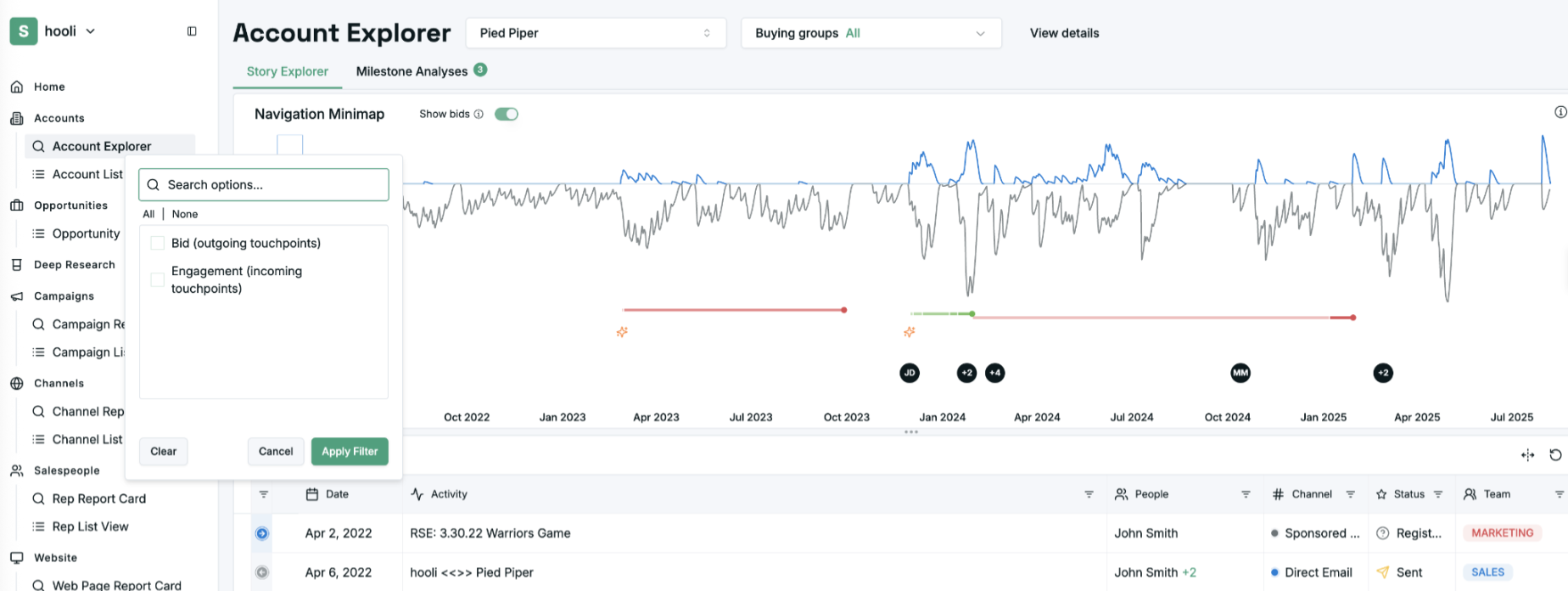
Upside's Data Foundation does this work automatically and keeps doing it as new data arrives. Pipedash and every other Upside product read from the same reconstructed record.
04
How Upside's Pipedash approaches B2B attribution
Pipedash is Upside's multi-touch attribution product. It runs on the Data Foundation rather than replacing it: its analysts read the reconstructed record, not a raw CRM export.
Start from the reconstructed deal
Each analysis reads the full opportunity timeline, including the buying group and the touchpoints recovered from emails, calls, and notes.
Reason like an analyst team
Three independent AI analysts each read the whole deal and propose an allocation, citing a record, transcript, or email for every claim.
Weigh reasoning, not votes
A consensus judge follows the analysts where they agree and weighs their reasoning where they differ. If they differ too widely, it adds analysts: five, then seven.
357analysts, only when neededVerify every citation
A separate check confirms every cited record exists. If one does not, the whole deal goes back for re-analysis.
Every cited record exists: the analysis moves onA cited record is missing: the whole deal is re-analyzedAllocate the full deal value
100% of the deal value is split across touchpoints and a labeled pool for influence no touchpoint can carry, then rolled up by channel, team, and campaign.
The sample deal, with every share cited.
05
Tracked, extracted, and inferred evidence stay separate
Pipedash labels every influence by how it is known. Extracted touchpoints meet the same evidence bar as tracked ones; they were simply never logged. Inferred influence is kept separate and labeled as probabilistic.
Tracked
Already recorded
A touchpoint captured in a source system such as your CRM or marketing automation platform.
In the sample deal
Webinar program
Six webinar registrations logged over five years.
Extracted
Recovered and cited
A referral, stakeholder, or meeting that was never logged but is evidenced in a call, email, or note.
In the sample deal
Peer recommendation
No CRM record. Recovered from the demo notes, where the buyer mentioned a former colleague.
Inferred
Probabilistic context
Influence with no citable touchpoint that context strongly implies.
In the sample deal
Brand awareness
No discrete touchpoint, but three and a half years of marketing exposure across the buying group.
06
The form captured the hand-raise, but earned 0% attribution credit
A last-touch model gives the demo request 100% because it was the last recorded conversion. Pipedash gives it 0%. Credit belongs to whoever created the activity, not to the buyer's reaction to it.
Your teamBuyer
A webinar, an SDR call, an email, a blog post
Earns credit
Third partyBuyer
A peer referral, an advisor intro, a press mention
Earns credit
BuyerYour team
A form fill, an email reply, meeting attendance
Always 0%
In the sample deal, the buyer attended webinars, engaged with content, received SDR outreach and email, and heard a peer recommendation before submitting a demo request. Those influences share the credit, and 22% goes to the pool for influence no touchpoint can carry.
The purpose is not to punish the form. It is to avoid telling the team that the best way to find more demand is to build more forms.
07
What teams can do with better B2B attribution
The output matters only if it changes a decision and survives inspection.

Graphite found referrals behind more than half of its deals
Upside's analysis of two years of Graphite deals:
53%
of deals came from referrals
$10M+
influenced by referrals across 40 closed-won deals
Almost none of those referrals showed up in the CRM. Graphite had stopped running events because attribution showed no impact. The analysis showed the people referring the most deals had attended Graphite events, and events restarted.


Cresta turns messy enterprise cycles into plain-language deal stories
Cresta first brought Upside in to solve attribution. Milestone analysis now turns a deal's full history of calls, emails, conferences, and SDR touches into a story of how it actually happened.
“Real life is messy. Enterprise cycles are messy. Upside accurately reflects that messy reality, which I think is rare and was impossible before.”
Stephen Daniels, VP, GTM & Strategic Operations, Cresta
08
Attribution is not incrementality
Attribution and incrementality answer different questions. Pipedash can make the observed account journey more complete, inspectable, and useful. It cannot prove what would have happened in a world where a campaign, referral, or event never occurred.
Attribution asks
What contributed to the observed outcome?
Reconstruct the journey, allocate observed contribution, and generate hypotheses.
Incrementality asks
What would not have happened otherwise?
Estimate causal lift against a counterfactual using a treatment and control or another credible experimental design.
Use experiments, lift studies, or other causal methods when the decision requires proof of incremental impact and the data volume allows it. Google's Conversion Lift explanation describes one experimental approach.
09
Who Pipedash is for
- Opportunities are valuable enough to justify deal-level analysis.
- Sales cycles are long, multi-person, and cross-channel.
- Important evidence lives in CRM, email, call transcripts, meetings, and marketing systems.
- Leadership needs to inspect why a program received credit.
- The team wants attribution tied to planning and GTM action.
When another method may fit better
- The business closes tens of thousands of small, similar transactions each quarter.
- The team needs a quick read on whether a live campaign is working.
- Source data is unavailable or cannot be connected.
- The real question is causal lift and a controlled experiment is feasible.
- Leadership will not review the assumptions or evidence behind the numbers.
Limitations to understand before you choose any model
No B2B attribution system can observe every influence. Private buyer conversations, memory, competitive research, and timing can remain invisible.
3 to 7
AI analysts read each deal, so it costs more than a fixed formula
Up to an hour
per analyst, so results are not instant
Closed deals
what it analyzes to guide where to invest, not a live read on campaigns
- Its quality depends on the connected data and reconstruction underneath it.
- Evidence supports an attribution hypothesis. It does not create experimental causality.
- A cited result can still be challenged. The citation makes that challenge productive.
The technical Pipedash article describes the current architecture and limitations in more detail.
10
How to evaluate B2B attribution software
Ask every vendor, including Upside, to show you these ten things. Tick each one as you get a real answer.
0 of 10 answered
The fastest evaluation is a deal your team already knows. If the result cannot survive that conversation, the portfolio dashboard will not earn trust either.
11
B2B attribution questions, answered
Definitions, method boundaries, and practical implementation details.
What is the difference between marketing attribution and revenue attribution?
Marketing attribution usually focuses on marketing activities connected to a conversion or opportunity. Revenue attribution connects activity across the go-to-market team to pipeline and closed revenue. In complex B2B journeys, that broader view is often more useful because marketing, sales, SDRs, partners, and customers can all contribute.
What is multi-touch attribution?
Multi-touch attribution distributes credit across several interactions instead of giving 100% to one touch. The model can use equal weights, milestone weights, time decay, statistical patterns, custom rules, or evidence-based reasoning.
Why is last-touch attribution misleading in B2B?
The last recorded touch is often the event that captured demand, such as a demo request or branded search. It may be operationally important, but it can hide the content, events, referrals, relationships, and sales work that built buyer readiness.
How does B2B attribution handle dark social or offline influence?
It cannot observe every private interaction directly. A stronger system looks for citable references inside calls, emails, notes, and meetings, then distinguishes recovered evidence from probabilistic inference. Unresolved influence should remain visible rather than being assigned to the nearest tracked event.
Does Pipedash replace experiments or marketing mix modeling?
No. Pipedash reconstructs and allocates contribution within observed B2B deals. Experiments estimate incremental lift using a counterfactual. Marketing mix modeling estimates aggregate relationships across time and spend. The methods answer different questions and can be used together.
Does the Pipedash allocation always add up to 100%?
Yes. For each analyzed opportunity, Pipedash allocates the full value across evidenced contributors and the explicit inferred pool. Channel and team roll-ups therefore do not double-count the same deal value.
Can Pipedash name a single source for each deal?
Yes. Alongside the multi-touch allocation, Pipedash identifies an opportunity source for each deal. It separates the hand-raise, the moment the buyer acted, from the source, the upstream event without which the deal would not have started. Both trace to cited evidence.
What data does Pipedash need?
Pipedash runs on the Upside Data Foundation, which connects to your existing systems through guided OAuth, with no field mapping. Typical sources include CRM, marketing automation, email, calendar, call transcripts, and web activity. The exact source set depends on the business and the question.
How quickly can a team trust an attribution system?
Do not judge this only by implementation time. Trust comes from testing known deals, inspecting the evidence, comparing the output with the team's direct knowledge, and documenting the model's assumptions. A credible vendor should show where the answer is uncertain.
Methodology and sources
This page distinguishes general B2B attribution guidance from Upside product claims. Product descriptions are based on Upside's public platform, Pipedash, and Data Foundation pages, the revenue attribution use case, the Pipedash methodology article, The Untracked Half research, and published customer stories, as reviewed on November 12, 2026.
Attribution explains observed contribution. Incrementality estimates causal lift against a counterfactual. Neither a cited attribution result nor this page is experimental proof of causality.

Start with a known deal
See what your current model missed
The fastest way to evaluate Pipedash is to run it on a deal your team already understands, then inspect the reconstruction and challenge the allocation.