See the whole of every deal.
Upside connects your GTM systems and rebuilds what your CRM never captured, or captured but never made sense of: the people, the touchpoints, and the buying groups behind every deal, reassembled into one record you can actually trust.
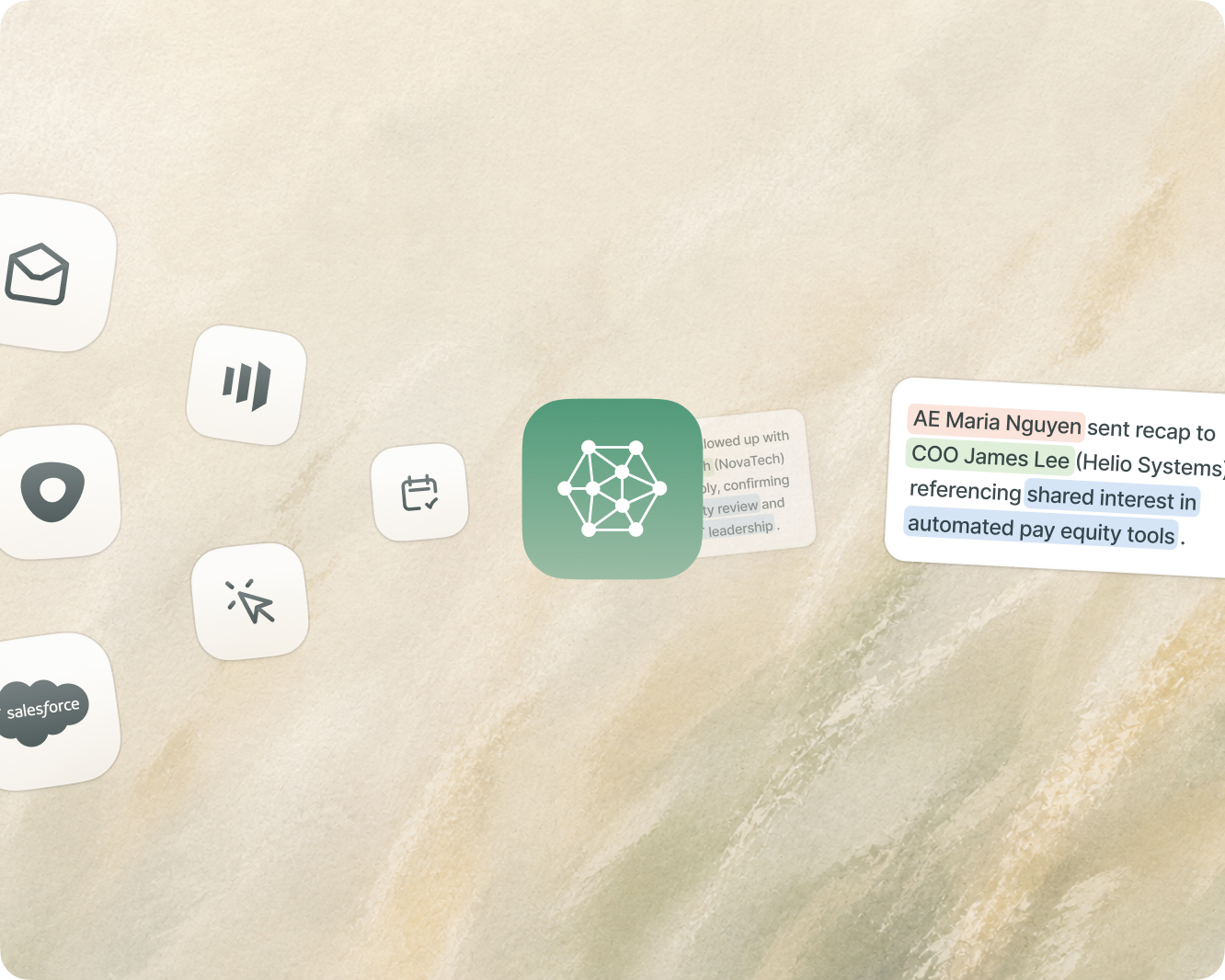
One trustworthy record under every decision.
Your dashboards, models, and agents all sit on top of your data. When the layer underneath is wrong, every answer inherits the error.
Reconstruct what your CRM never recorded.
Your CRM was built to run deals, not remember them. AI turned those structural gaps into the thing holding everything back. The same kinds of gaps show up in every CRM.
None of this is a discipline problem your team can fix by logging more carefully, or by kicking off another CRM cleanup next quarter. It is structural.
Turn on the sources. Map nothing by hand.
Getting to good data usually starts with a quarter of data engineering, before anyone sees a single clean record.
Connect, don’t build.
Native connectors for the major GTM systems, plus webhook ingestion for the long tail that has none. A few OAuth clicks, no pipelines to maintain.
Crawled, not just synced.
Upside’s forensic reconstruction then indexes your systems the way a search engine crawls the web: every email, meeting, call, and record into one shared schema.
 Salesforce
 HubSpot
 Gong
Gong Marketo
 RB2Bwebhook
Northwind
one schema
One person. One record.
One real person is scattered across your systems, a Lead here, a Contact there, a name on a call, and counted as several different people.
One canonical identity.
Upside collapses those fragments into one person, and keeps doing it as new data lands, so analytics count real people instead of system artifacts.
Across companies, too.
The same logic recognizes a person who appears in two different account datasets as one human, not two.
Salesforce · Lead
“John Okafor”
Salesforce · Contact
“J. Okafor”
HubSpot · Contact
jokafor@nw.com
Gong · participant
speaker on 3 calls
John Okafor
VP Operations
1 canonical person4 source records merged
Every touchpoint, even the ones no one logged.
Most of what happens on a deal never gets logged, so attribution and account scoring run on a fraction of the story.
It reads what was never logged.
Upside extracts the interactions buried in email threads, call transcripts, and CRM notes, and adds them to the timeline.
Email threads, reassembled.
A six-reply forwarded chain stops reading as one touchpoint; inferred participants (“Tom said:” with no send record) are added as real contacts.
Dated to when it happened.
Each recovered touchpoint is placed by the date in the email or transcript it came from, not the date a system happened to sync it.
No new logging discipline.
Recovery happens in the pipeline, not in a habit you have to enforce on reps and marketers.
Northwind deal timeline
● logged◌ recoveredJan 22 · Peer referral from a Comply exec
found in email: “…you should really talk to Northwind…”
Feb 2 · Mentioned at an exec roundtable
named on call transcript, Feb 9
Feb 10 · Demo request (form)
Feb 18 · Intro call (Gong)
Feb 24 · CFO looped in on a forwarded thread
inferred participant, no send record
Mar 12 · Pricing review (meeting)
The whole buying committee.
B2B deals are decided by a committee, but much of that committee never makes it into the CRM.
Stitched from real activity.
Upside rebuilds the full group across CRM records, email threads, and call transcripts, including the stakeholders a rep never added.
Both paths walked.
Direct account contacts and opportunity roles, so no one in the room gets dropped.
CRM Contact Role
John Okafor
VP Ops
Reconstructed buying group (9)
+ 5 more recovered

“We had no idea how many people were referring deals to us. Upside looked at all of the data and showed us the full picture.”
The layer the rest of the platform runs on.
Every other Upside capability runs on this same reconstructed record, which is what lets the numbers trace back to a source.
Attribution and analyst-quality research run on the reconstructed record, not raw CRM exports.
Account timelines, explorers, and report cards render the healed data, with provenance back to source.
Questions? Answers.
The details behind how Upside reconstructs your GTM data, and where it fits alongside the tools you already run.
Isn’t this just a CDP, a reverse-ETL tool, or our data warehouse?
Those move data; Upside makes it correct. A warehouse or CDP will faithfully replicate the duplicates, missing touchpoints, and incomplete buying groups that already exist in your source systems. Upside runs a reconstruction and healing pipeline on top: it resolves identities, recovers the interactions that were never logged, reassembles buying groups, and classifies activity, then serves the result as a normalized record. It is the layer between your systems and your analysis, not another place to store the same raw data.
Do we need a data team to set this up?
No. Sources connect through guided OAuth flows, with no ETL infrastructure to build and no field mapping to maintain. The reconstruction and healing run automatically once data is flowing, so you do not need a data engineer to stand it up or keep it clean.
Does this replace our CRM?
No. Upside reads from Salesforce, HubSpot, and the rest of your stack and leaves them as your systems of record. Nothing changes about how reps and marketers work. Upside builds a reconstructed, unified record alongside your CRM, not in place of it.
What happens to our history when we switch a GTM tool?
It stays. Your data lives in Upside’s foundation, not the tools it came from, so when you swap one system for another, say Marketo for HubSpot, the history is already here. Upside stitches the new system onto the old, reporting spans the cutover on one timeline, and the record outlives the source’s own retention limits.
How do you recover touchpoints that were never logged? Is that just guessing?
No. Recovery is evidence-based: a touchpoint is added because it appears in an email thread, a call transcript, or a CRM note, and the record keeps the citation for where it came from. Where something is genuinely inferred rather than evidenced, it is labeled as inferred. The point is a more complete record you can audit, not a more optimistic one.

Build your GTM on data you can trust.
Book a demo and see what your team can build, automate, and finally answer once your GTM data is something you trust.