

What three closed-won analyses reveal about demand capture and demand creation.
Most B2B attribution systems give too much credit to the hand-raise.
Forms, demo requests, and inbound messages are clean, time-stamped events. The activities that created buyer preference often are not: an article forwarded internally, prior product experience, years of trust, or the arrival of a real buying window.
When attribution starts with structured touchpoints, it rewards what the system can observe rather than what changed the buyer's mind.
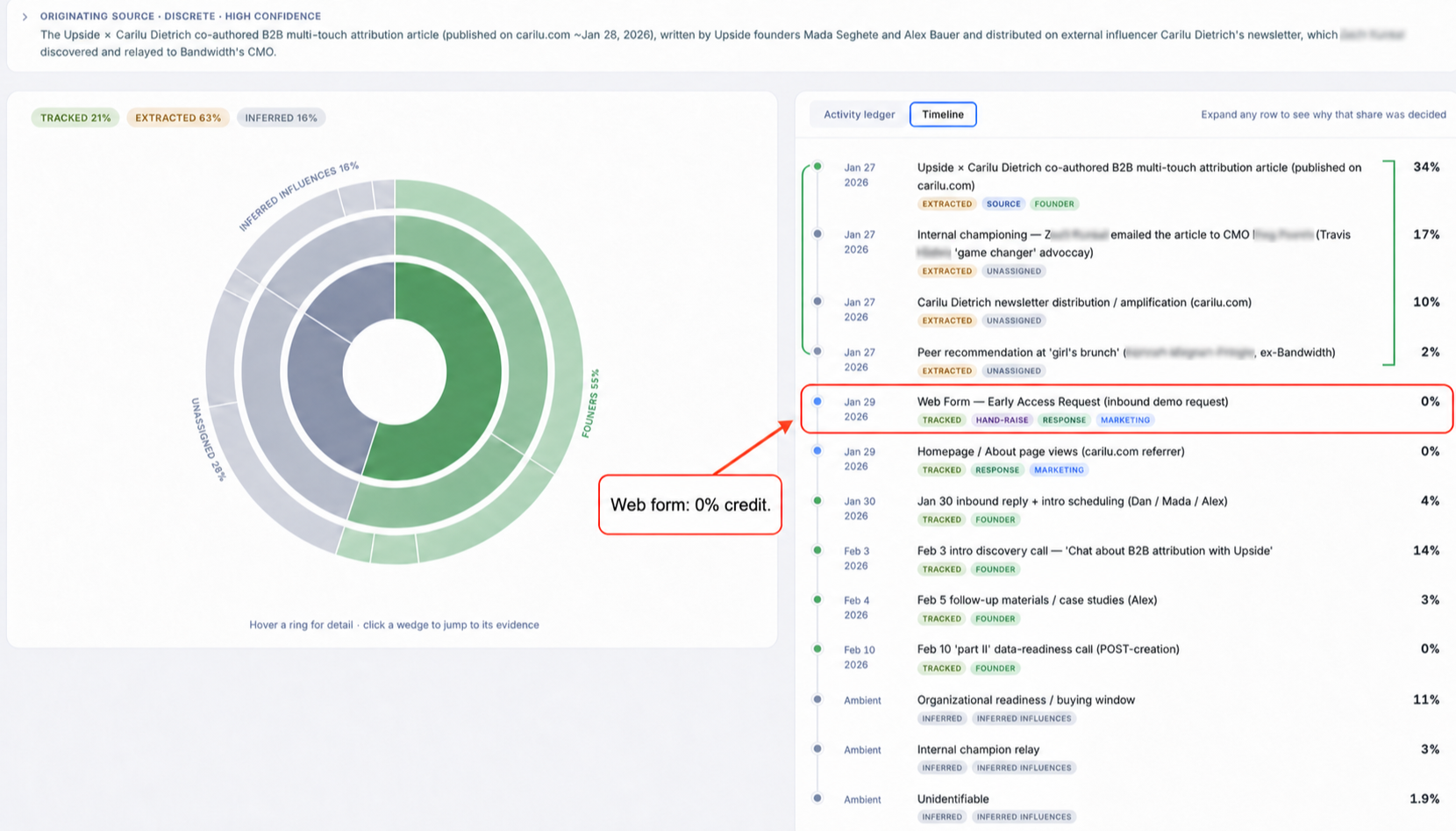
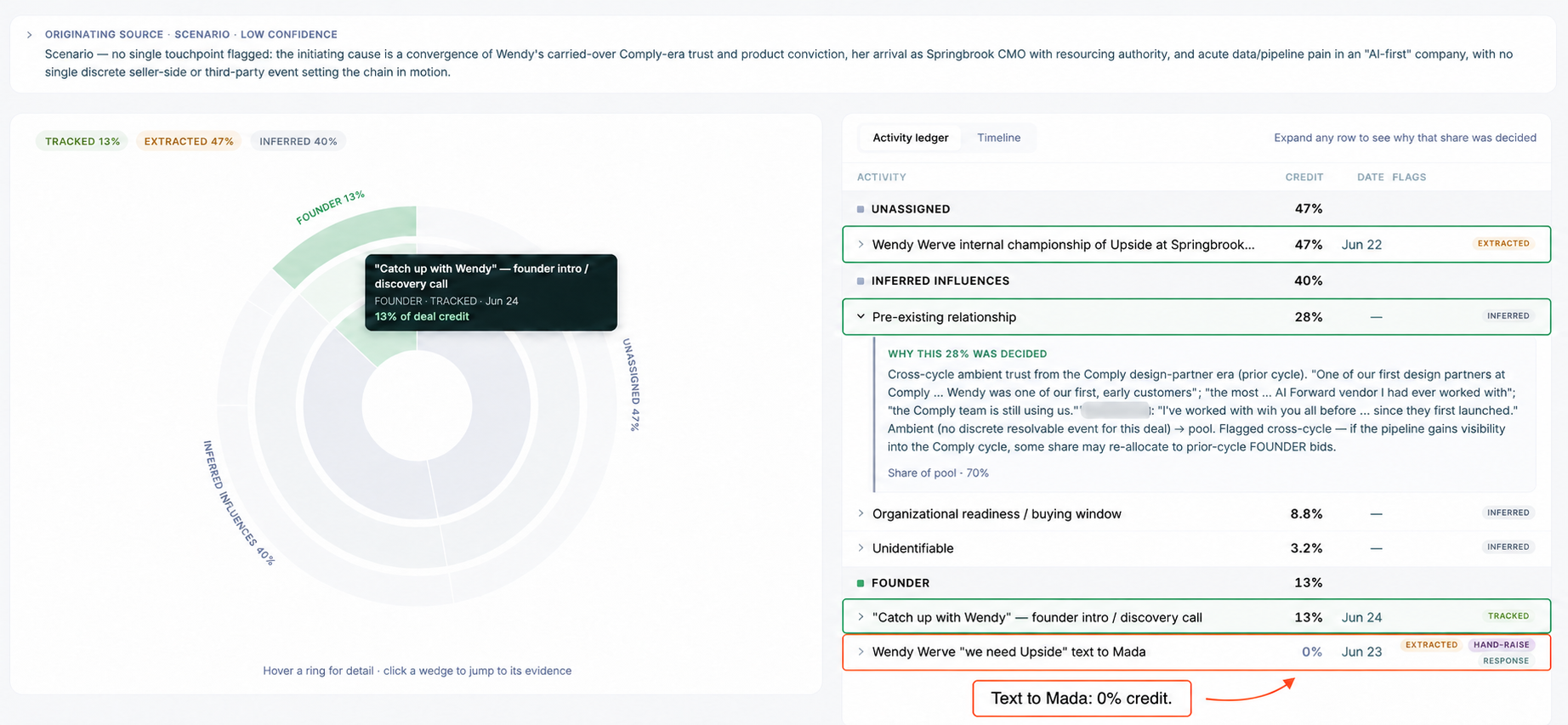
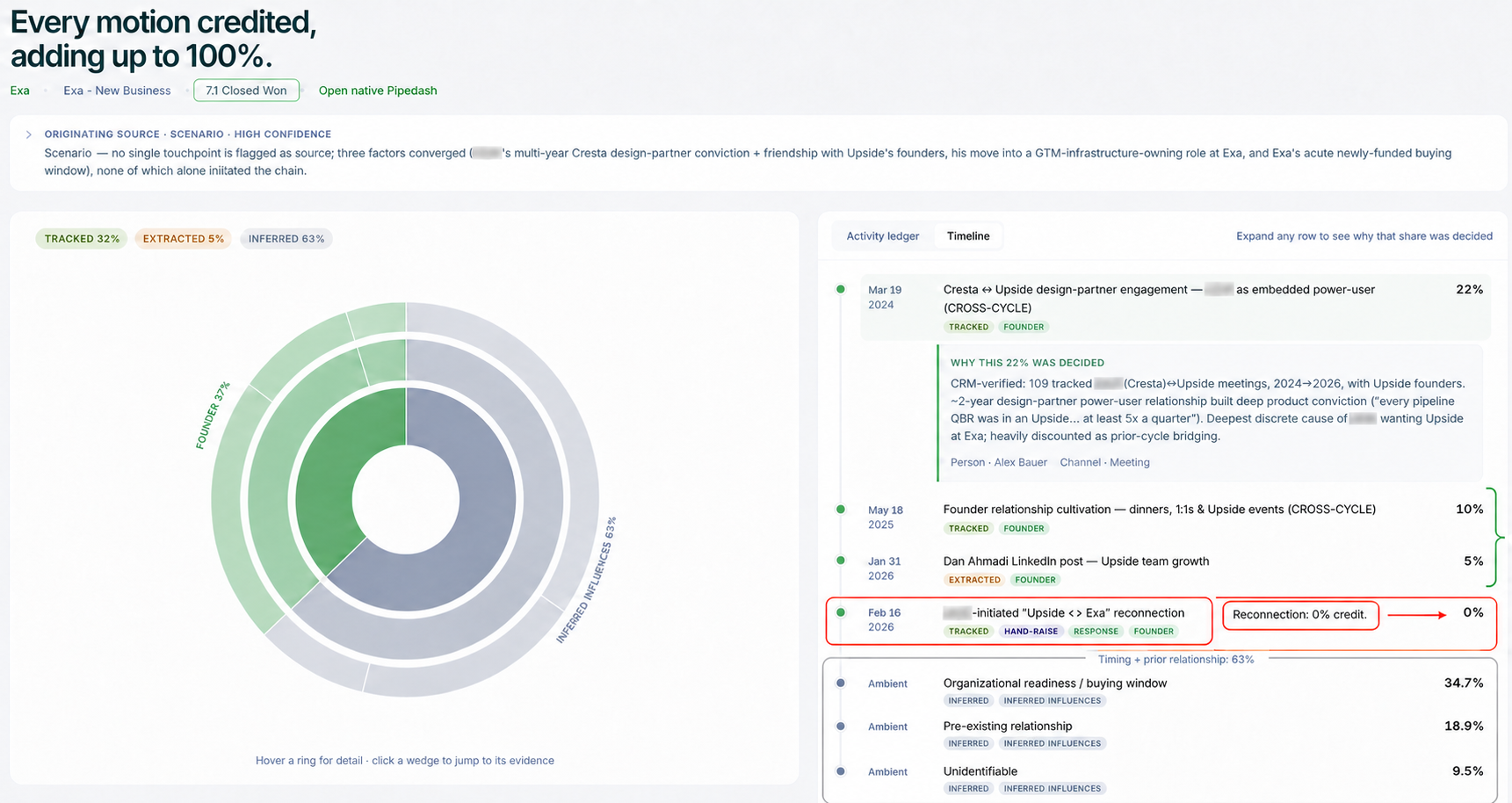
We saw this when we ran Pipedash across three recent closed-won deals from our own pipeline. In every deal, the clearest hand-raise received 0% credit:
- A demo request form
- A text saying "we need Upside"
- A buyer proactively reconnecting
These events still mattered. They were valuable buying signals. But they captured demand that earlier activities had created.
That distinction changes the action. If a form gets credit for demand created by content, the team optimizes the form. If the content gets credit, the team can invest in what actually created buyer readiness.
Why attribution over-credits visible events
Traditional models distribute credit among the events they can see. The weakness is not the arithmetic. It is the evidence set.
Much of the B2B journey lives outside campaign fields, inside calls, emails, product history, internal forwarding, peer conversations, and relationships that carry across companies.
A useful analysis distinguishes among the source that set the journey in motion, the influences that built trust or conviction, and the response that revealed the buyer was ready. A response should not receive explanatory credit simply because it has the cleanest timestamp.
How we analyzed our own deals
Upside reconstructs the account journey across CRM, marketing, email, calendar, and call data. Pipedash uses that timeline to evaluate what worked and why.
We built a small miniapp inside Upside using our live Pipedash results. It removed deal values while preserving the percentage allocation, timeline, and evidence behind each decision.
Pipedash separates tracked activities already present in GTM systems, extracted evidence found in calls and emails, and inferred influences that mattered but could not be tied honestly to one event. Every deal adds up to 100%, without manufacturing precision the evidence cannot support.
Deal one: the form recorded demand; it did not create it
A piece of thought leadership received 34% of the credit. Internal forwarding received 17%, newsletter distribution 10%, and an offline peer recommendation 2%.
The demo request form received 0%.
A conventional report would likely classify this as an inbound conversion and make the form the hero. The reconstructed journey showed that content created interest, distribution extended its reach, and internal and peer validation built conviction.
The form told the team the buyer was ready. It did not explain why.
Deal two: a new opportunity was not a new journey
Internal championing received 47%, the pre-existing relationship 28%, and the discovery call 13%.
The buyer then sent a text saying "we need Upside." It received 0%.
The message was a clear hand-raise, but the conviction came from prior product experience and years of trust. That history moved with the champion into a new role.
The CRM saw a new opportunity. The buyer did not experience a new journey.
Deal three: uncertainty was part of the answer
Prior product experience received 22%, relationship cultivation 10%, and a LinkedIn post that brought Upside back to mind 5%.
The buyer's proactive reconnection received 0%. The largest category was 63% inferred.
That inferred share included timing, organizational readiness, and influence the evidence could not resolve precisely. Forcing it into the visible activities would have produced a cleaner answer, but a less honest one.
An inferred pool is a boundary on the claim. It shows where specific evidence ends and uncertainty begins.
What this changes
Attribution should separate demand capture from demand creation, include unstructured and cross-cycle evidence, and preserve uncertainty instead of assigning every point of credit with false confidence.
For us, the results support investing in thought leadership worth forwarding, the people and channels that help ideas travel, better tools for internal champions, and long-term product trust.
Three deals show a pattern, not a statistical conclusion. Attribution is also not incrementality. Attribution reconstructs an observed journey; incrementality estimates what would have happened without a program, usually through experiments or a credible counterfactual.
Pipedash gives teams a more complete and defensible account of what happened in complex B2B deals. It does not turn post-hoc evidence into a causal experiment.
The wrong question is:
Which tracked activity sourced this deal?
The better question is:
What evidence explains why the buyer became ready, and which motions should we repeat?
If you want to see what Pipedash finds in your own closed deals, book a demo.